High Republic Era
Temple Uniform
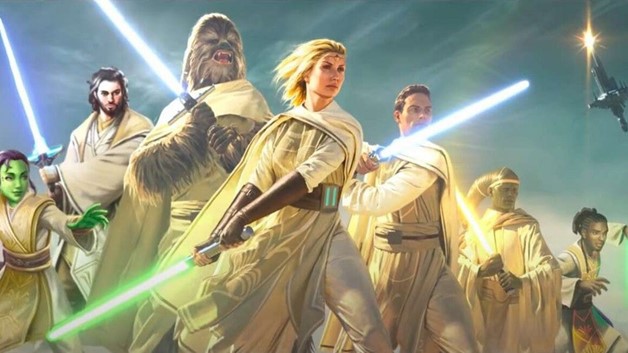
High Republic formal temple uniforms are worn by Jedi in the High Republic era for formal occasions where combat is not expected.
They are generally clean, luxurious, and highly ornamental.
Requirements
The following minimum items are required for approval:
- Outer tunic
- Inner tunic OR midcoat
- Tabards
- Obi OR sash
- Trousers OR skirt
- Belt
- Boots
- Lightsaber
These items are also required in certain conditions:
- Leggings or tights
- Required IF a skirt is worn
Colors
All items that are not made of leather must be shades of white, cream, or gold. All fabrics should be unpatterned and appear as solid colors. While rich golds are permitted, yellows and oranges may be too bright. Leather/ leather-like goods must be shades of brown or gold, and may have gold metallic trim.
FOR PADAWANS ONLY: sashes may be bright blue or green in shade that match references.
Materials
Fabrics of the high republic formal uniforms are generally more luxurious than those of other types of Jedi. They still have rich textures, but may in some cases have a higher sheen. As such, some fabrics that are normally permitted for Jedi will not be permitted for High Republic Formal Temple uniforms, and while some fabrics that are NOT normally permitted for Jedi are appropriate.
Permitted Fabrics
silk dupioni, silk twill, silk matka, matte silk taffeta, wool crepe (single and double), fine linen
Possibly Permitted
These fabrics may be permitted but should be reviewed by GCCs before use
Raime, coarse linen, silk noil, synthetic dupioni, synthetic twill, cotton suiting, wool suiting, wool or synthetic melton (for cloaks only), silk or synthetic georgette or crepe.
Disallowed Fabrics
Smooth satins including habutais, velvets, velveteens, most other cottons (including cotton gauze and osnaburg), leather for items other than boots/belts/belt accessories, any other fabrics referenced in the main addendum as being unapprovable
Belts, pouches, saber holsters, and boots must be leather or leather-like.
Required Items
High Republic Temple uniforms must at minimum have an outer tunic, an inner tunic OR a midcoat, tabards, an obi OR sash, a belt, and boots.
Outer Tunic
Outer tunics are worn over inner tunics and pants/skirts, and under all other layers.
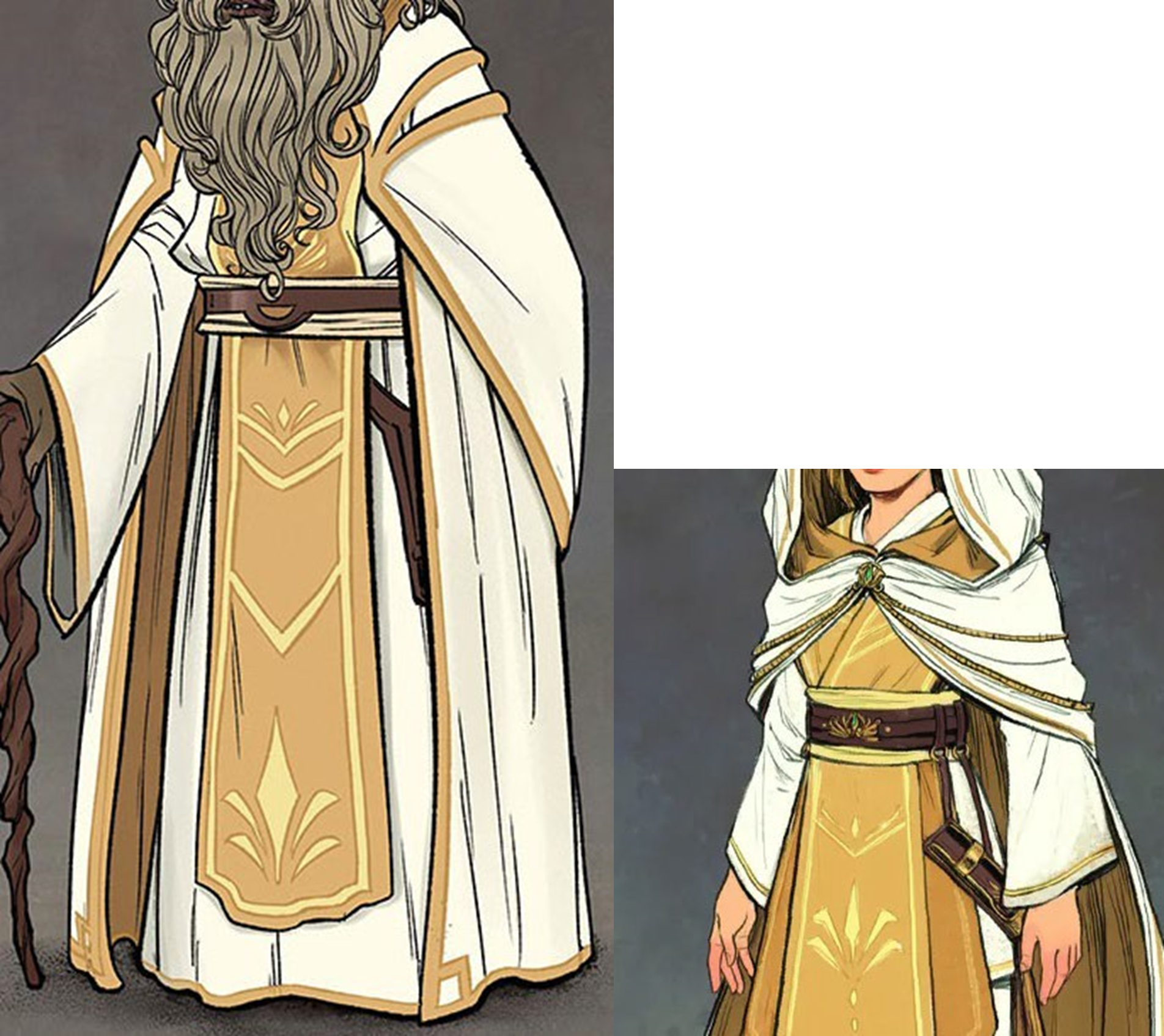
Outer tunics follow all construction and and rules from the main addendum, except for the following:
– Tunic skirts may be slit up to just below the obi as long as a skirt is worn underneath
– Tunic skirts may have no visible wrapping below the belt and instead be a solid section, though this is not required
– Outer tunics may not be shorter than inner tunics
– Outer tunics may not have sleeves that are tapered inward to the wrist, and may have sleeves that are wider than those of tunics approved under the main addendum.
– Outer tunics may have metallic trim, braid, or piping (though they may not have any other ornamentation)
– Outer tunics may have visible vertical darts to achieve a tailored shape.
– Outer tunic hems may come to a point in the front and back.
– If a midcoat is worn instead of an inner tunic, the outer tunic may not be sleeveless.
– If the outer tunic sleeves are ¾ length, then either armlets must be worn, or else the inner tunic must have full length fitted sleeves.
Outer tunic must be cream or white rather than gold. Tunic may be lined in a contrasting color within the gold/white/cream color palette.
Inner Tunic
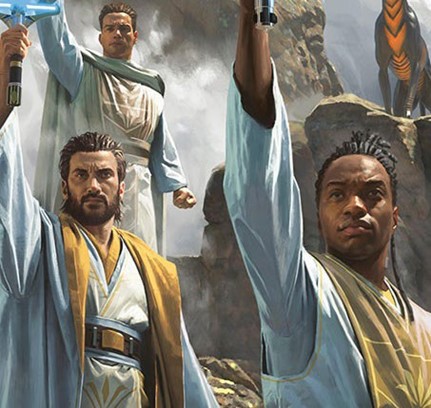
Formal temple uniforms must have either inner tunics OR midcoats, though they may have both if desired. Inner tunics, if worn, follow all construction and fit rules from the main addendum, except:
– They may not be longer than the outer tunic in the skirt area.
– If a sleeveless outer tunic is worn, inner tunics must have sleeves. Those sleeves may be wider than those of tunics approved under the main addendum, and may not taper inward to the wrist.
– If a sleeveless outer tunic is worn and the inner tunic sleeves are ¾ length, armlets must be worn (see optional items).
Midcoat
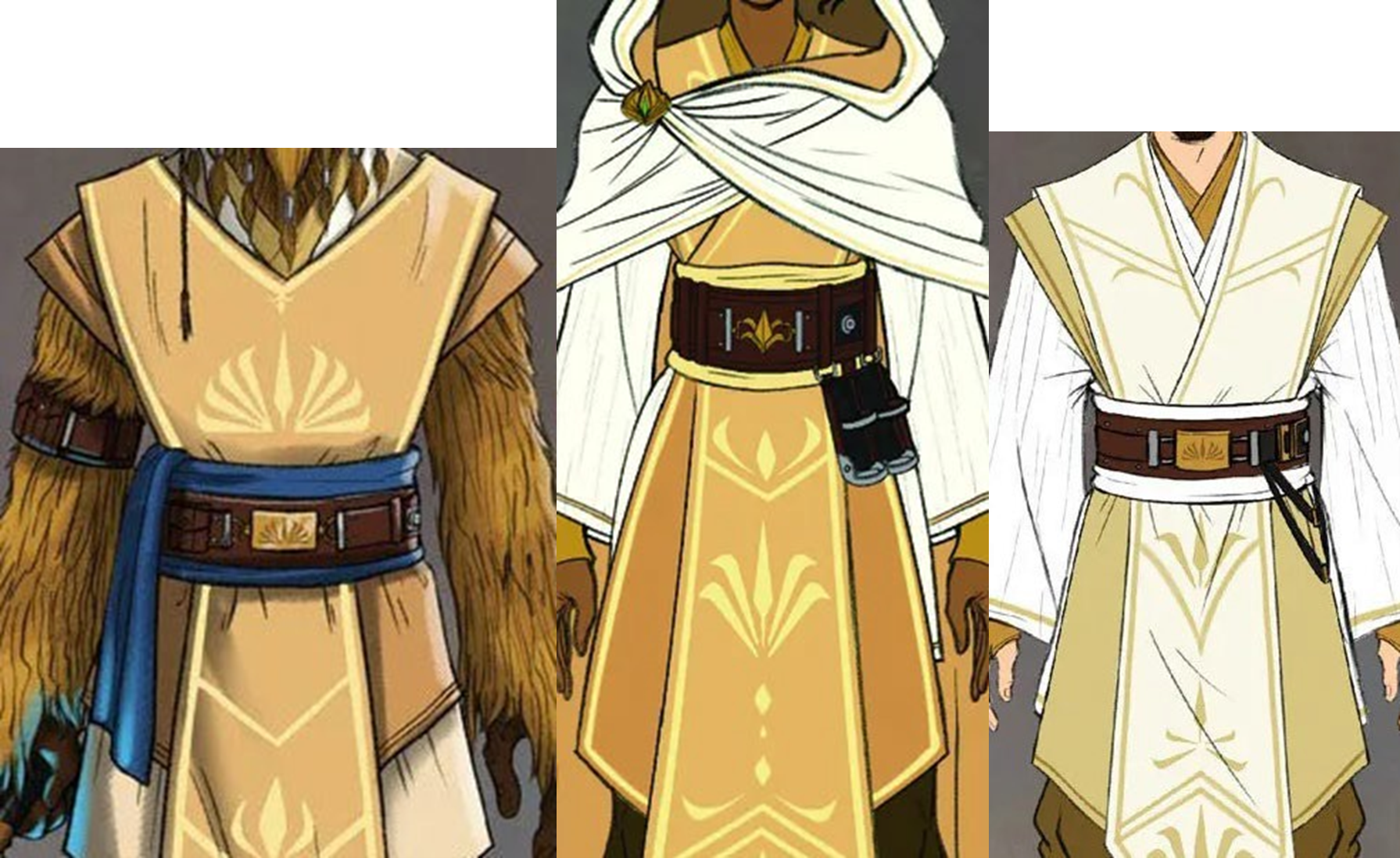
Formal temple uniforms must have either inner tunics OR midcoats, though they may have both if desired. Midcoats are worn over the outer tunic and under the obi and tabards. They should slip on over the head and may be visible above the tabards at the neck. They can either have a v neck or a wrapped neckline like a standard tunic. They can either be closed at the sides or fully open, though they should at minimum be wider than the tabards at most visible points.
They may extend up to 2 inches beyond the shoulder, so as to ensure their visibility under tabards. Midcoats may be as short as lower hip length and as long as 1-2 inches longer than the tabards, provided that they are at least an inch off the ground. Midcoats may have any of the following ornamentation in cream or gold: piping along edges, trim along edges, simple geometric ornamentation in the corners. They should have no other ornamentation beyond that.
Tabards
Two types of tabards are permitted for the formal high republic uniforms: Y tabards, and medieval tabards. These are both unique to the High Republic, and may not be used for any other era.
Both types may have ends that are either chevron shaped or rectangular. They should be at least knee length, and may extend to the midcalf. They should not extend more than an inch beyond the shoulder.
High republic tabards must have heraldic designs and ornamentation in the white/cream/gold color palate. These designs must be symmetrical. It is recommended that these designs be at least somewhat contrasting within that color palate. Designs may be implemented as combinations of applique, machine or hand embroidery, vinyl transfer, piping or soutache, or stenciled fabric paint, provided that the technique used is neat and regular in appearance.
Symbols used must either appear on existing High Republic Jedi uniforms, or must be pre- approved by the GCCs. It is strongly recommended that full tabard designs be pre-approved before construction begins.
All tabard types are permitted, though not required, to have a standing collar which is open in front. They should have no visible closures, and must be open on the sides. They should also have no visible seams other than collar seams, though hidden seams at the waist are permitted as long as they are covered by the obi.
Medieval Tabards
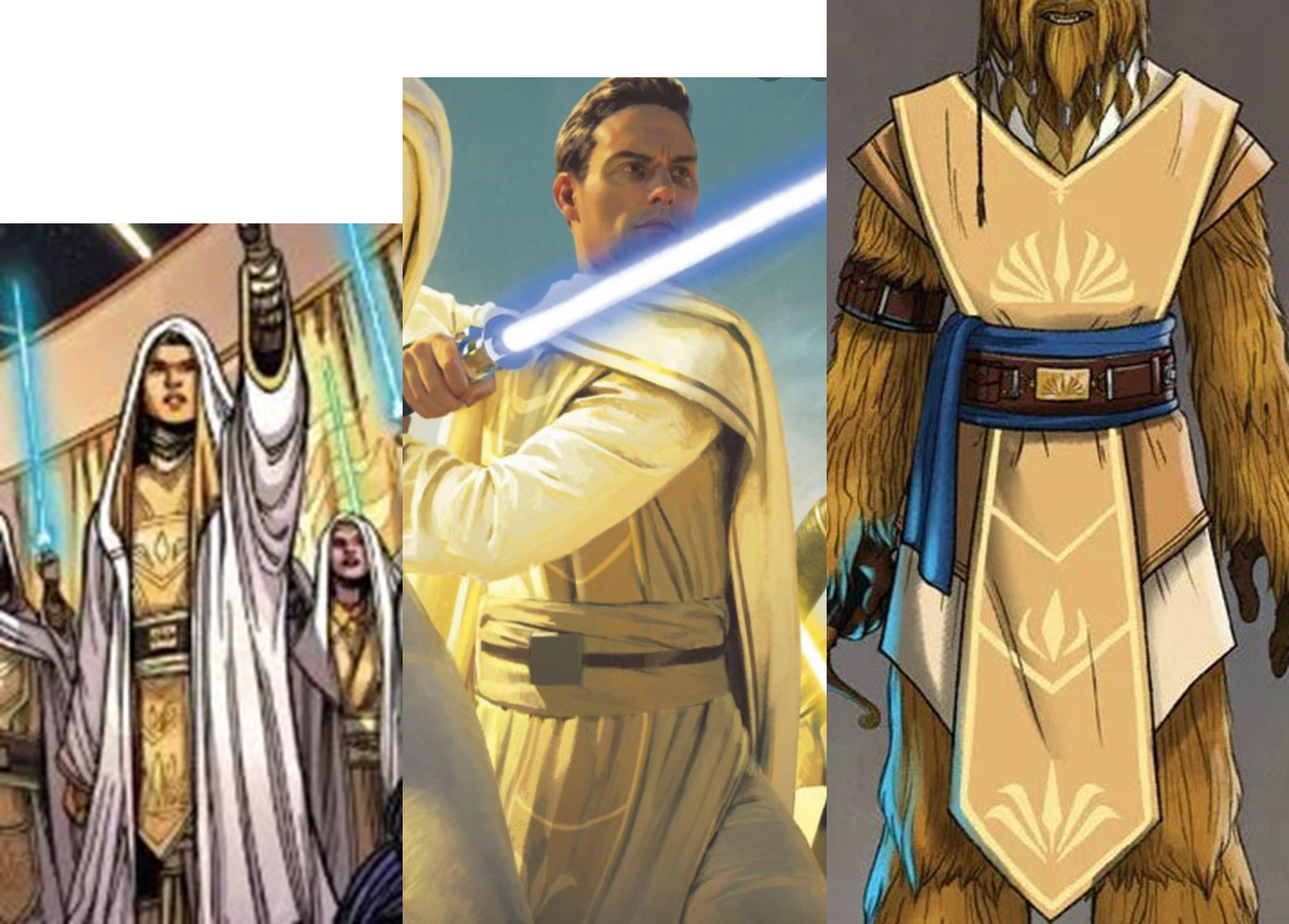
Medieval tabards are a single piece front and back. They should have an opening for the head that is either v-neck, square, or shallow round. Medieval tabards may taper somewhat in the body, but should still cover most of the chest. They may also taper back out somewhat below the obi.
Y Tabards
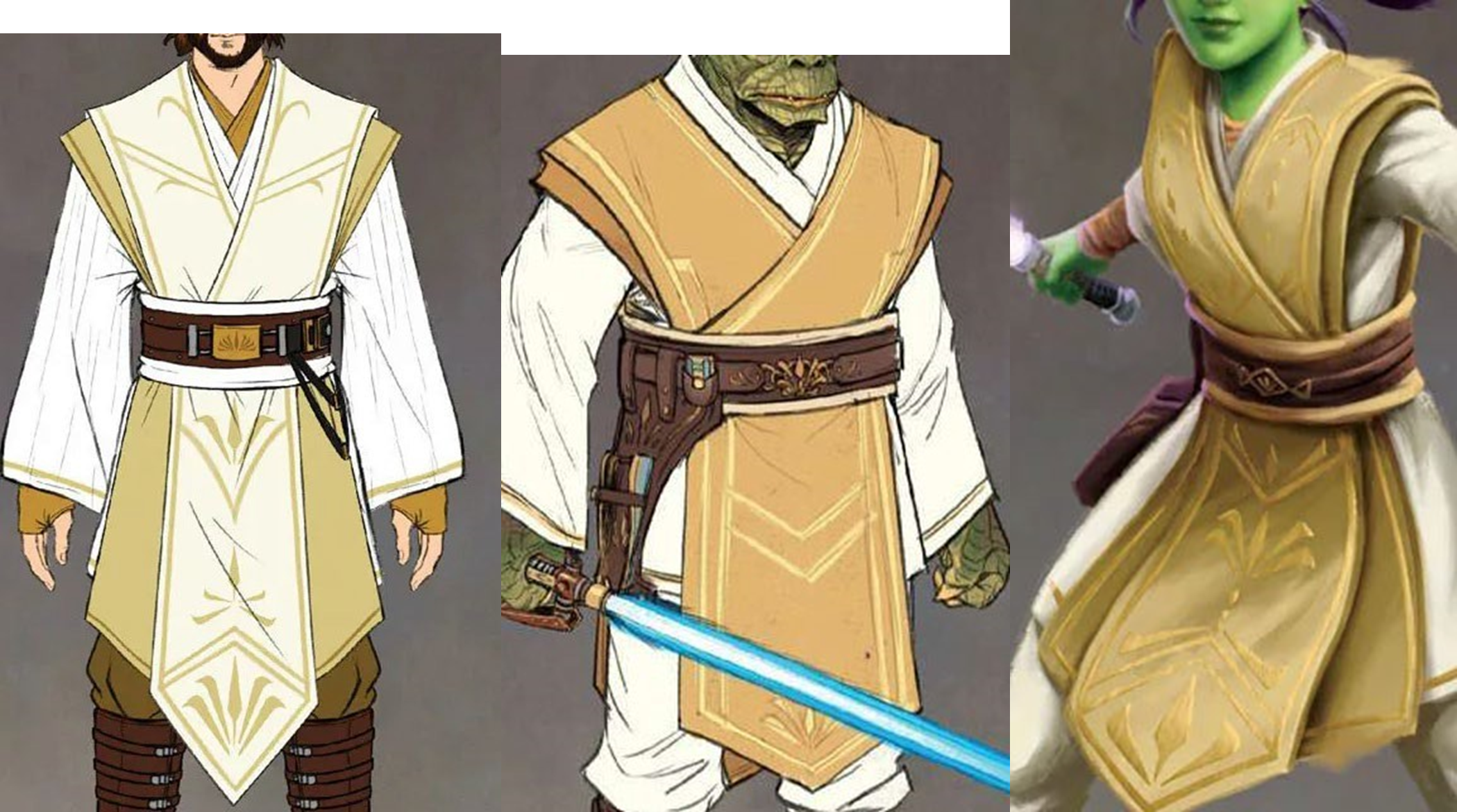
Pants of Skirt
Pants and skirts follow all rules of construction and fit from the main addendum, though they are limited to the gold/cream/white color palate of the High Republic. Pants and skirts should be a solid color and have no trim or ornamentation.
Obi or Sash
Obis or sashes are worn over the tabards and under the belt. Knight and master character must have an obi, while Padawan characters must have sashes. Obis and sashes are never worn together.
Obi
Obis follow all rules of fit and construction from the main addendum.
Sash
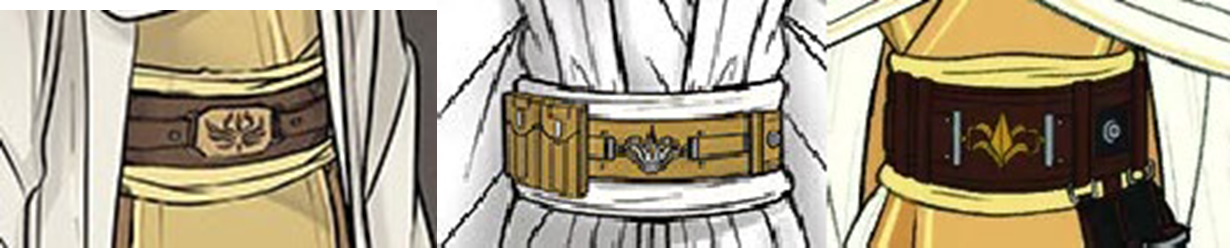
Padawan characters may choose to wear a sash instead of an obi. Sashes should fully circle the waist and be visible above and below the belt, and have a long tail that hangs down to the knee at the front or on the right side. They should have no ornamentation, and appear to be made from a single piece of fabric. Sashes should not be stiff and should drape freely on the hanging end.
Belt
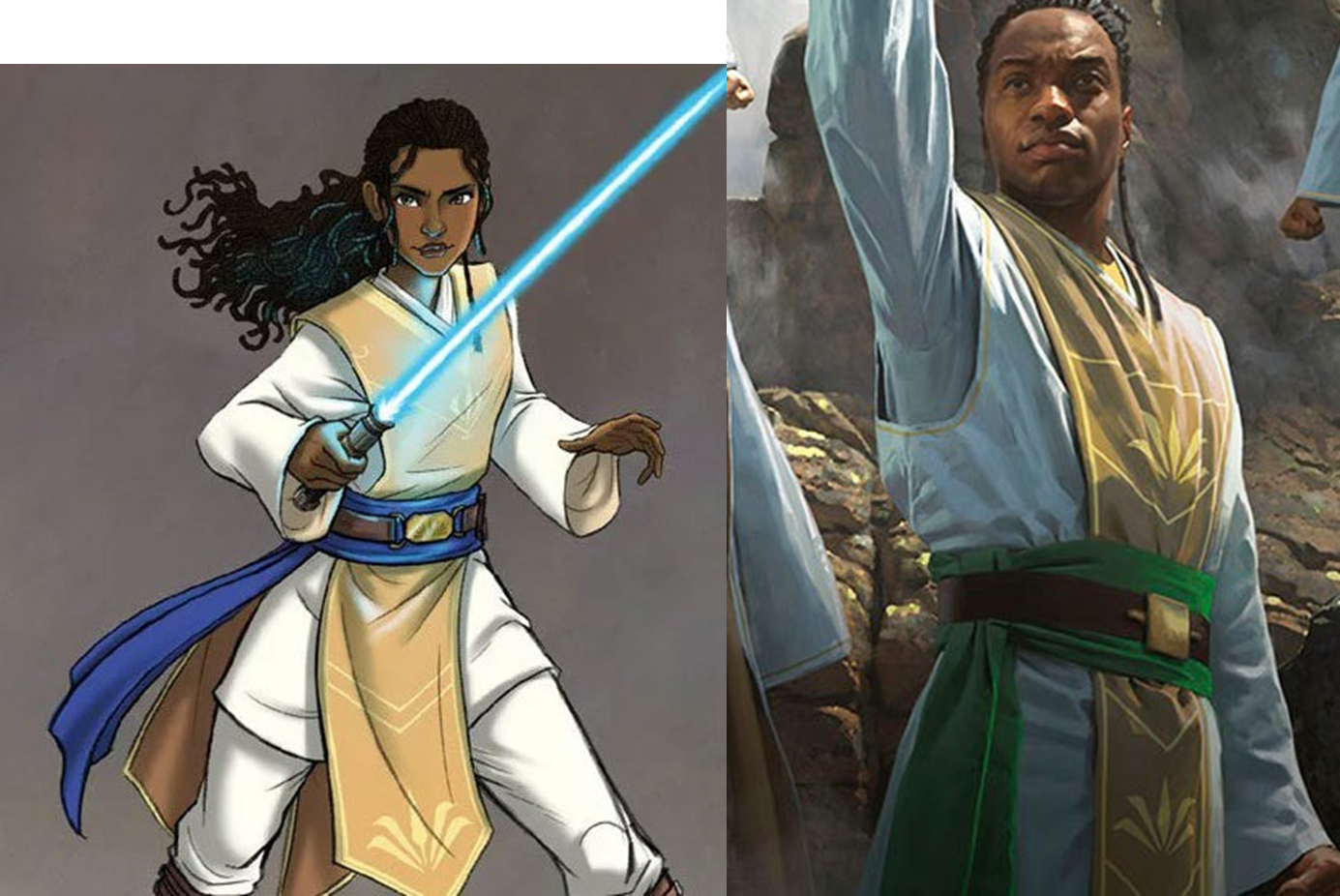
High republic belts are brown leather with metal accents and gold buckles. Like belts from the main addendum, they must appear continuous. They can feature ornamentation in the form of metallic trim and metallic studs or loops in gold or silver. Buckles may be plan geometric plates, geometric plates embossed or stamped with designs reminiscent of the heraldry on tabards, or be novel shapes based on said heraldry. The leather of belts is not embossed with patterns or heraldry.
Two general styles may be made without pre-approval: Original Trilogy, or Prequel
Original Trilogy Based Belt
These belts feature a single strip of leather at least 1 inch wide and no wider than 2.5 inches, with a single large buckle in the middle front. Like original trilogy belts, they do not feature excessive holes or large keepers. They may feature metallic bands or rings to attach the leather to the buckle.
Prequel Based Belt
Prequel based belts feature the classic two-layer construction with a wider belt and a narrower belt.. The wider belt should be between 2 and 3 inches. The narrow belt end ends at a buckle in the middle front, and the wider belt ends at the back with ends hidden by a keeper. The ends of the narrow belt may be tapered to where they meet the buckle.
Other novel belt designs are also permitted, but must be pre-approved by the GCCs.
Boots
Boots follow all rules of construction and fit from the main addendum, except for the following:
– Wraps may not be used in lieu of properly fitted leather/leather-like boots
Saber
Sabers follow all rules from the main addendum.
High republic features such as gold ornamentation are permitted but not required.
For Padawan characters using a sash rather than an obi, it is recommended (but not required) that the saber color match the sash color.
Optional Items
High Republic Temple Uniforms may have any or all of the following optional items. Please note that no other optional items from the main addendum are permitted.
Cloak, Cape, or Robe
Capes, cloaks, and robes follow all rules of fit and construction from the main addendum EXCEPT
– They may end at calf or ankle length and instead of ending a couple of inches off the ground
– They may be lined in contrasting fabric within the gold/white/cream color palate
– They may feature metallic trim, piping, or braid, though other types of patterns are not permitted.
– They may fasten with gold toned brooches and/or chains. Other types of visible fasteners may also be permitted if canon references from the High Republic are provided. If brooches are used, then the jewelry standards below apply.
– Capes and cloaks may fasten asymmetrically
– Capes and cloaks may have an added capelet layer in the shoulder area. If this layer is included it should be the same color as the rest of the cape or cloak.
– Robes may have ¾ length sleeves.
Saber Holster
Saber holsters hang from the belt. They are made of leather or leather-like material with metal accents, and should functionally suspend a saber hilt when it has no blade attached. All saber holsters should either replicate an existing design from the high republic or be pre-approved by the GCCs.
Belt Pouch
Pouches follow all rules of construction and ornamentation from the main addendum, except for the following:
– Pouches may feature gold metallic trim
Jewelry
High republic Jedi may have subdued jewelry in the form of brooches, tiaras, cloak chains, and/or earrings. All jewelry should be gold tone, and may feature subtle gemstones. Jewelry designs should either be simple geometric shapes, or based on existing Jedi symbols in the high republic. All jewelry designs must be pre-approved by the GCCs.
Armlets
Armlets follow all rules of fit and construction from the main addendum. They may feature metallic trim, piping, or braid, but should have no other ornamentation.
Mission Uniform
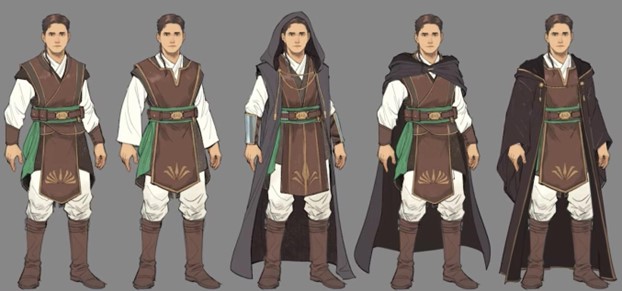
High Republic mission outfits were worn by the Jedi during the High Republic era when they go into the galaxy and expect action. The colors are browns of varying shades for the outer tunic, white for the under tunics, and a variety of browns for tabards and obi.
Colors
All items not made of leather or metal share similar color schemes of brown and white/cream across mission outfits except where otherwise stated. Tabards should be a medium brown to slightly reddish brown. Outer tunics should be a darker shade of brown than the tabards, and can border on dark enough to appear almost black. Cap sleeves on the outer tunic should be the same color as the outer tunic. Shoulder pads should be the same color and material as the outer tunic if both are in the same costume. Pants/skirts should be white, cream, light to medium brown, golden brown or golden.
For Padawans only: Sashes are recommended to (But not required)match the color of your lightsaber blade.
Materials
Materials used should be durable since Jedi get into trouble when wearing these uniforms. Boots should be leather or leather like, as should gloves. All clothing parts should be of a durable material of medium to heavy weight and not be see-thru in any capacity. Materials used should not have additional patterns and patterned textures as concepts show a lack of excessive decoration.
Recommended Fabrics
Heavier, durable textured fabrics such as cotton twill, medium to heavy linens, duck cloth, wool suiting or melton wool, raw silk, microfiber, or other similar fabrics.
Disallowed Fabrics
Anything thin enough to be see-thru, shiny, has a sheen, or has a raised pattern. No quilting cotton, cotton sateen or sheer linens.
Required Items
Jedi mission outfits must have at minimum an outer tunic, an inner tunic, bracers, tabards, an obi or padawan sash, a Jedi belt with one pouch and a lightsaber clip, pants or a skirt, and boots.
Outer Tunic
Outer tunics are worn over the outer tunic and pants, but under tabards, obi and belt. The outer tunic should be a darker shade of brown than the tabards, and can border on dark enough to appear almost black. Any cap sleeves on the outer tunic should be the same color as the outer tunic. Shoulder pads should also be the same color and material as the outer tunic.
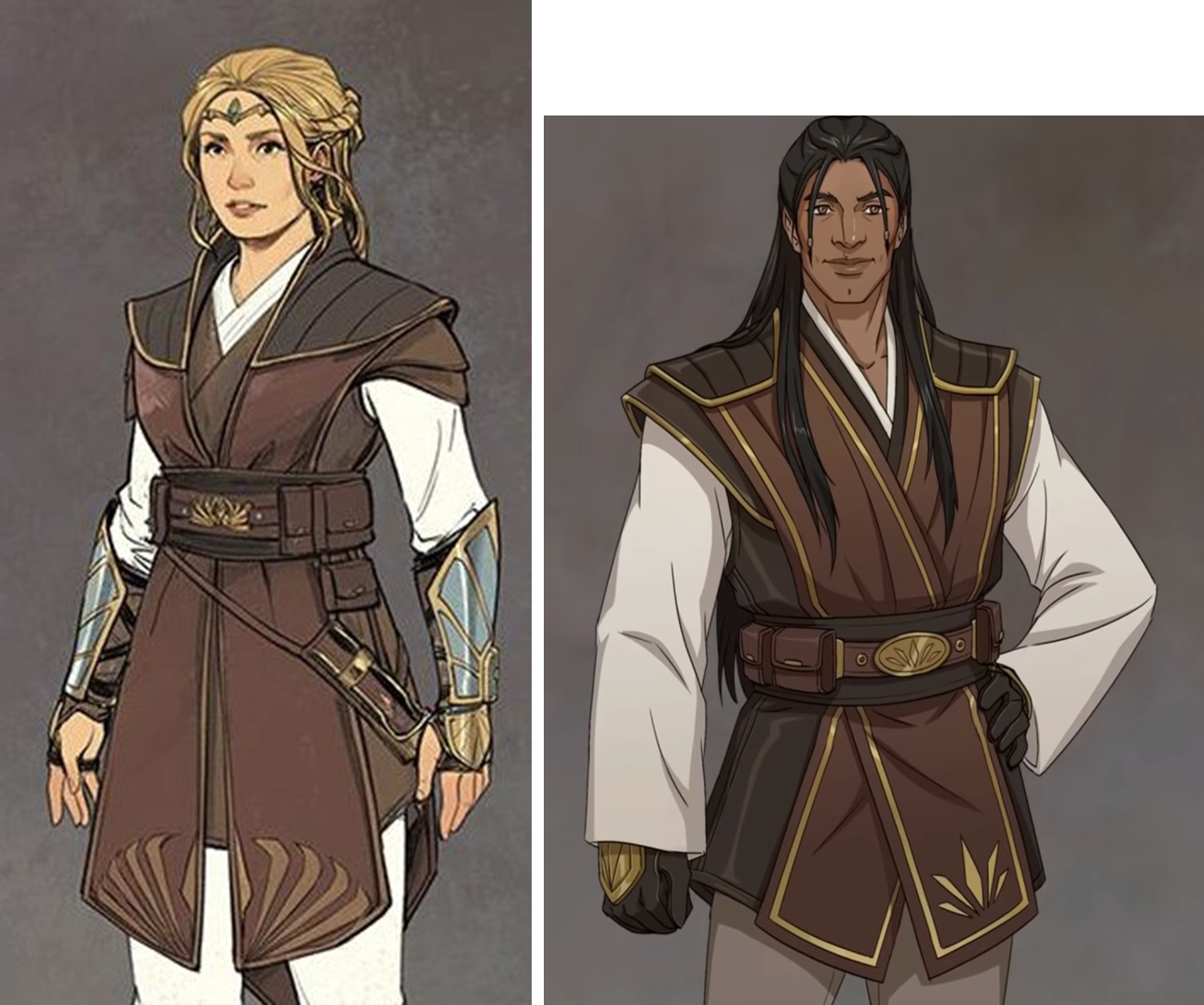
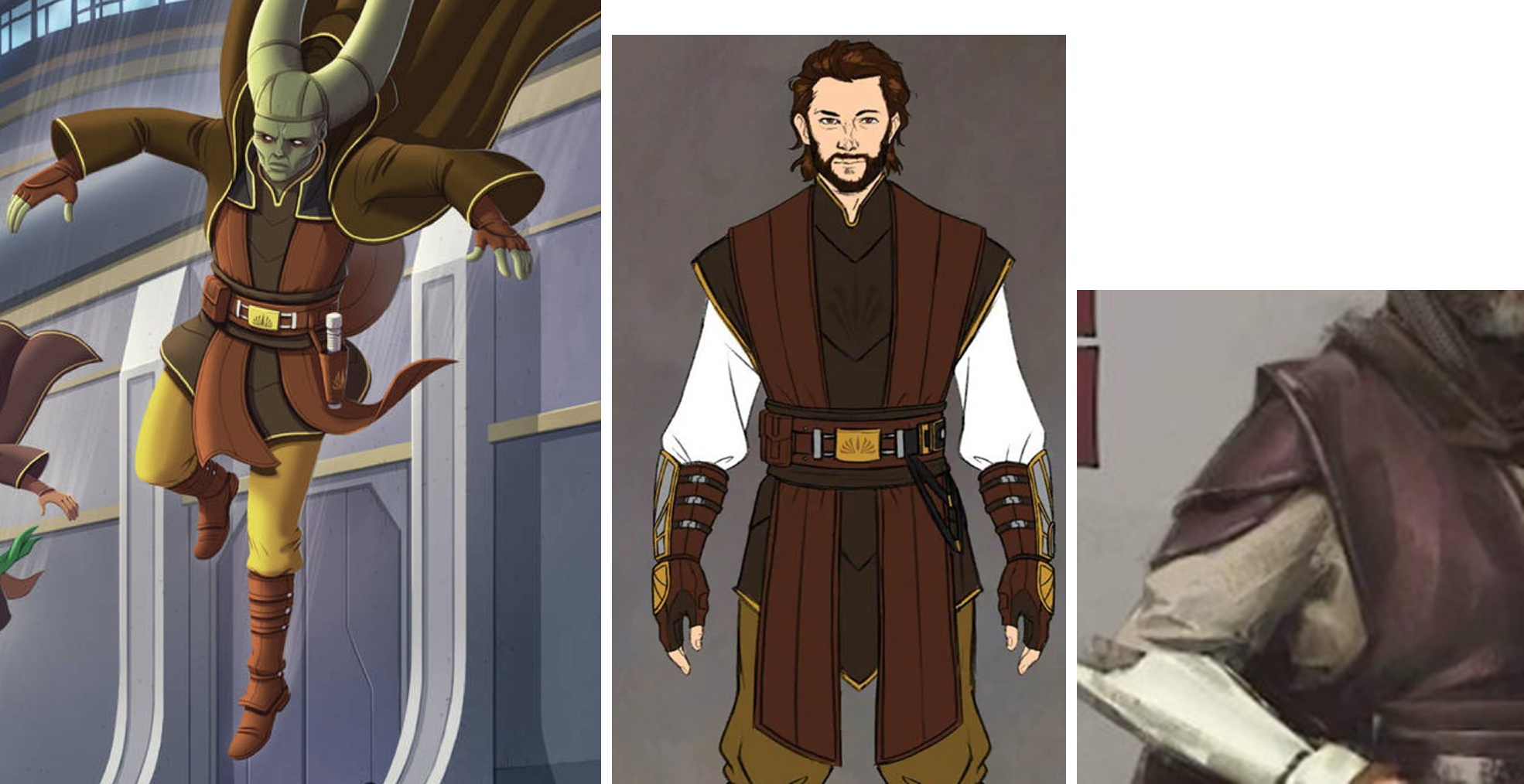
There are two common outer tunic styles found in concept and official art: Crossover and Surcoat. The Crossover outer tunic is the standard crossover-style tunic seen across eras for Jedi, just made of more durable materials. The Surcoat outer tunic can be either a plain or segmented tunic with no visible front or back opening that typically has a mandarin collar. Segmented outer tunics may have between 3-5 segmented sections that can be on the front section only. outer tunics are darker than tabards. They can range from darkish-medium brown to dark brown outer tunics follow all rules of main addendum with the following exceptions:
● outer tunics must be long enough to cover the crotch/backside
● outer tunics are either sleeveless, or have short single layer cap sleeves that extend less than 2 inches from the shoulder. Cap sleeves must be stiff and may be rounded or come to a central point.
● outer tunics may also have stylized cap sleeves in no more than two layers that extend to the middle of the bicep.
● outer tunics may have metallic trim, braid, or piping (though they may not have any other ornamentation)
● outer tunics may have visible vertical darts to achieve a tailored shape.
● outer tunic hems may come to a point in the front and back.
Inner Tunic
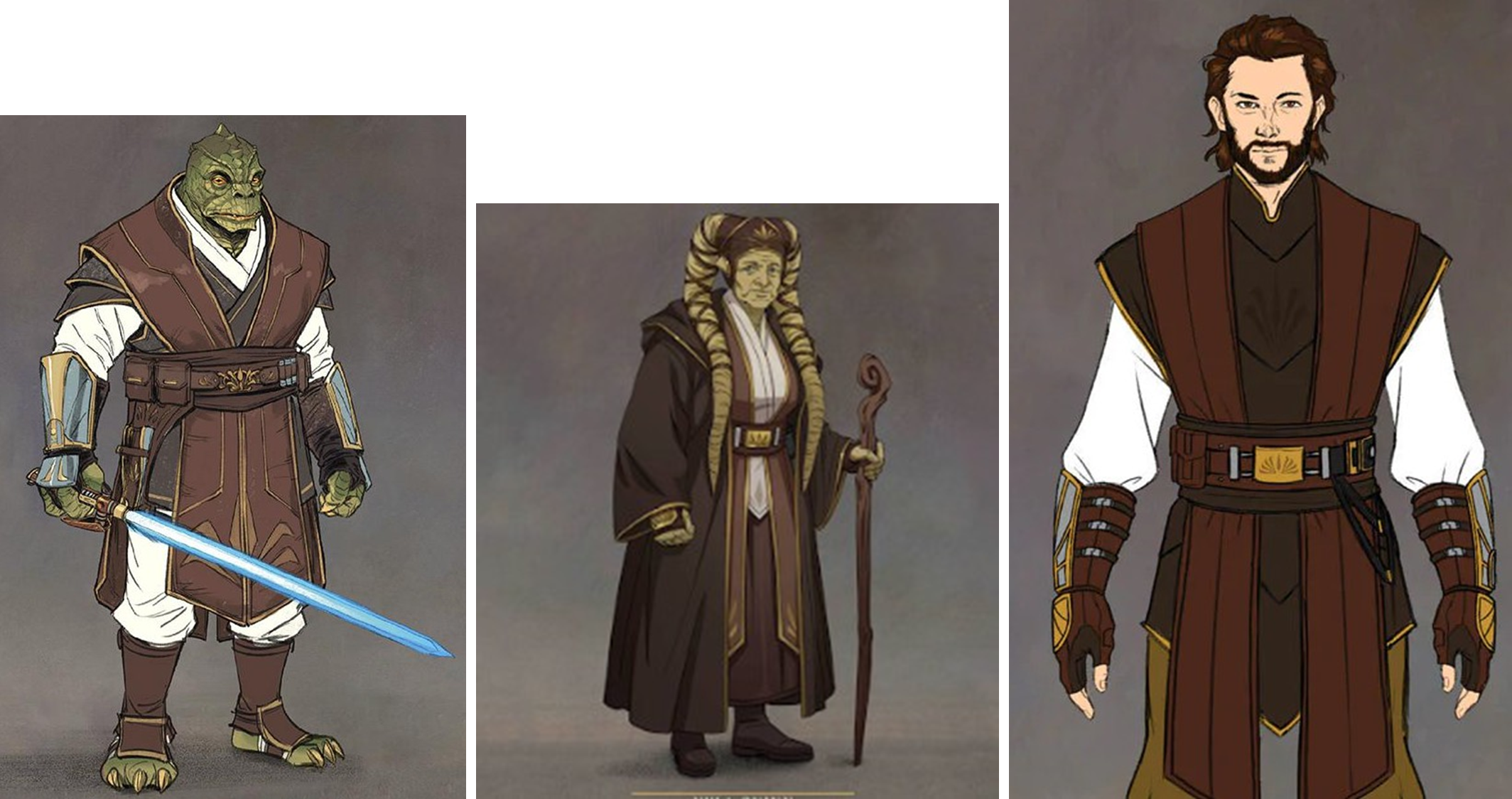
Inner tunics in the High Republic era are white. They are all long sleeved and should be tucked into the pants or skirt. They share the cross-over design of the standard Jedi over tunic. When worn with a standard cross-over outer tunic, the inner tunic’s collar should be visible. When worn with a segmented outer tunic, then only the sleeves need to be visible.
Tabards
Tabards for the High Republic are a way of individualization for the Jedi. Across concept art, book covers, and comics there is a huge variety in styles of High Republic era tabards. Generally the tabards are made of fabric, but can be leather or leather-like material. In the case that the tabards are constructed of leather or leather-like material, the obi does not need to be of the same material and may be fabric (please note this is a departure from the main Generic Jedi standard).
The standard draping over the shoulder tabards remains the most common style. This style can be worn a number of ways such as standard parallel lay, crossed over the chest, or closed below the obi in an apron style.
Tabards may also be
- Y-front with apron bottom front and back-embellishment does not need to extend to the back apron but does need to be on the tabards;
- Hybrid style per the main Generic Jedi standard;
- Medieval-style front and back with either a mandarin or v-neck collar and open sides.
- Vest-style with a mandarin collar and any of the following:
- Open sides,
- Closed sides
- The back wrapping around to the front above the belt;
- Y-style front and vest back with closed sides and a wide apron front and back
- Open sides,
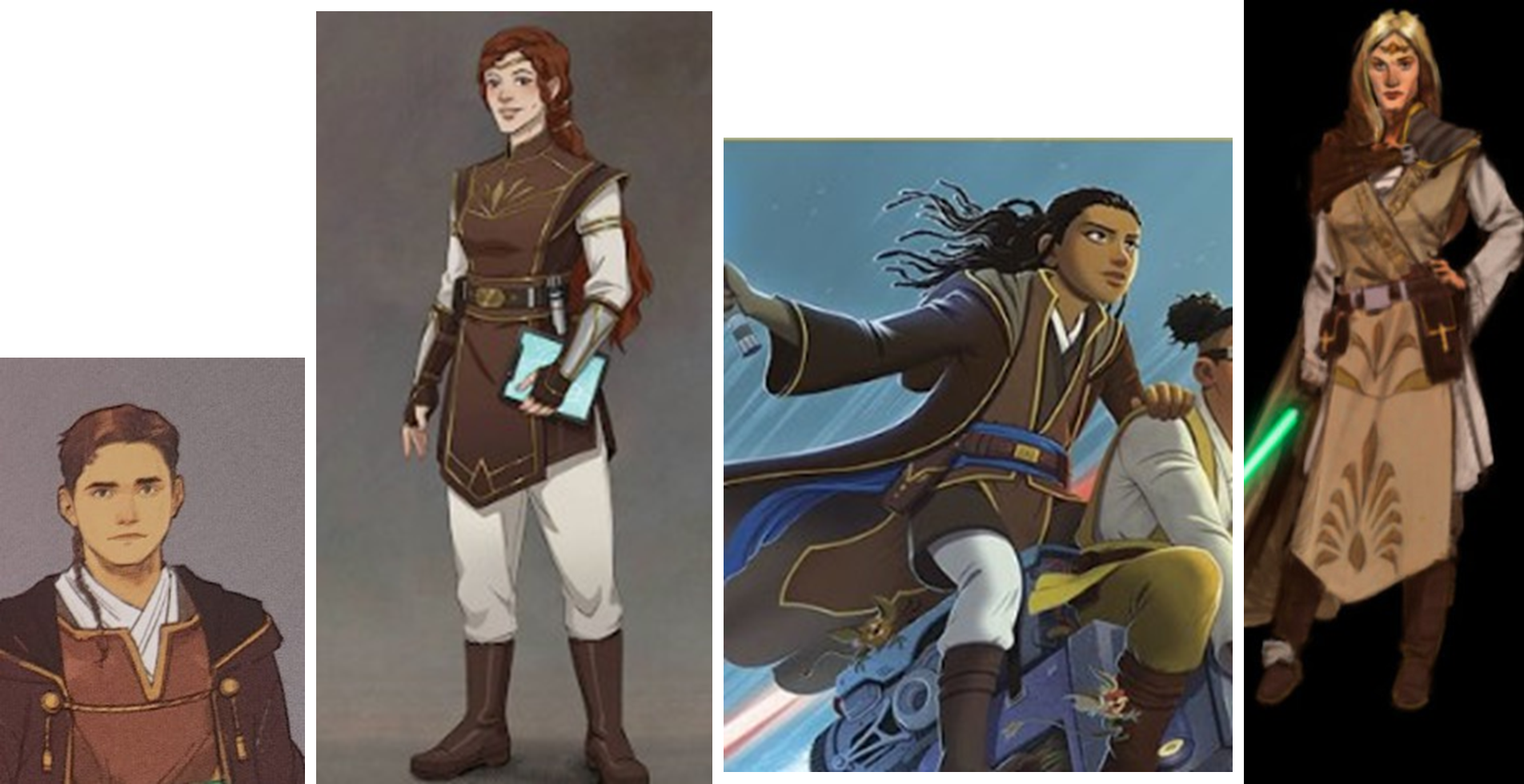
All tabard styles EXCEPT vest and medieval may end at the obi in the back.
Tabards should be of a lighter brown than the outer tunic and are typically of a medium or reddish-brown color. In rare instances, they can be light brown, so long as they are lighter in color than the outer tunic.
- Tabards should be longer than the outer tunic and range in length between the mid-thigh and knees
- Tabards may have metallic trim, braid, or piping so long as the trim does not exceed 1” in width. Trim may have simple geometric designs.
- While not required, a High Republic Jedi design on the bottom of the tabards is allowed. For the medieval style tabard the design may also be on the chest. This can be applique, embroidery, painted or vinyl so long as it is done neatly with no fraying, bunching or splashes.
- Simple lines or scrollwork may be used on the upper tabards, but design and placement must be presented to GCC prior to construction.
- Tabards can end in a flat or pointed style (points must be symmetrical)
Obi
Padawan Sash
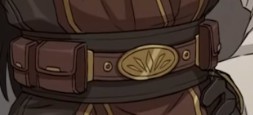
Padawan characters may choose to wear a sash instead of an obi. Sashes should fully circle the waist, be visible above and below the belt and have a long tail that hangs down to the knee at the front or on the right side. The knot of the sash must be below the belt and lie as flat as possible. They should have no ornamentation, and appear to be made from a single piece of fabric. Sashes should not be stiff and should drape freely on the hanging end. They are recommended to (but not required to) match the padawans blade color.
Belt
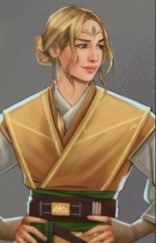
High republic belts are brown leather with metal accents and gold buckles. Like belts from the main addendum, they must appear continuous. They can feature ornamentation in the form of metallic trim and metallic studs or loops in gold or silver. Buckles may be plain geometric plates, geometric plates embossed or stamped with designs reminiscent of the heraldry on tabards, or be novel shapes based on said heraldry. The leather of belts is not embossed with patterns or heraldry. Belts must feature at least one pouch and a lightsaber clip. Three general styles may be made without pre-approval. Other belts may be used with approval from the Costuming team:
Original Trilogy Based Belt
These belts feature a single strip of leather at least 1 inch wide and no wider than 2.5 inches, with a single large buckle in the middle front. Like original trilogy belts, they do not feature excessive holes or large keepers. They may feature metallic bands or rings to attach the leather to the buckle.
Combo Belts
Prequel Based Belt
Prequel based belts feature the classic two-layer construction with a wider belt and a narrower belt. The wider belt should be between 2 and 3 inches. The narrow belt end ends at a buckle in the middle front, and the wider belt ends at the back with ends hidden by a keeper. The ends of the narrow belt may be tapered to where they meet the buckle. Other novel belt designs are also permitted, but must be pre-approved by the GCCs.
Belt Pouch
Pouches follow all rules of construction and ornamentation from the main addendum, except for the following
- Pouches may feature gold metallic trim
- Pouches may be suspended slightly below the belt by hidden straps or o-rings.
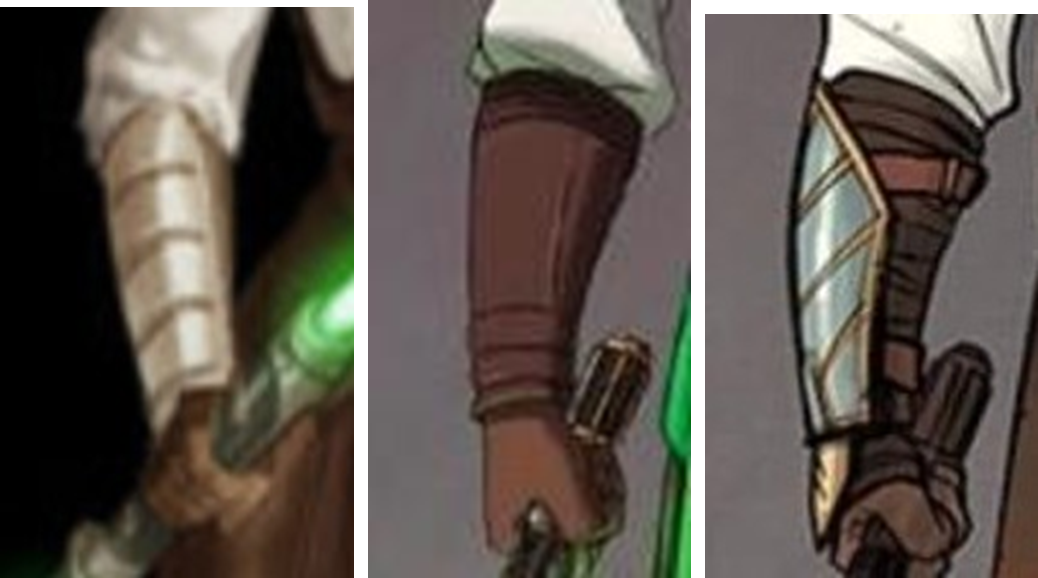
Forearm Covering
- A required layer that goes either over or under the sleeves
- Minimum length covers the wrist
- Maximum length is just below the elbow.
- Made from leather or fabric.
- Color is medium to dark brown
- Fasteners must be either hidden or along the inside of the forearm. Lacing must be concealed if used.
Adornments are limited to gold trim/gold detailing along the edge
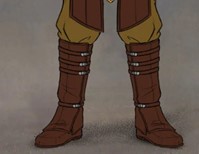
Boots
Boots follow all rules of construction and fit from the main addendum. The exception being that wrap boots are not allowed for this template.
Pants, Skirts and Leggings
Pants, skirts and leggings follow all rules from the main addendum EXCEPT:
- They must be in shades of white, ivory, tan, cream, light to medium brown, or dark gold.
- Skirt hems may have simple gold trim or braid around the hem.
Saber
Sabers follow all rules from the main addendum. High republic features such as gold ornamentation are permitted but not required.
For Padawan characters using a sash rather than an obi, it is recommended (but not required) that the saber color match the sash color.
Optional Items
High Republic Mission Robes may have any or all of the following optional items. Please note that no other optional items from the main addendum are permitted.
Jewelry
High Republic mission robes may include simple metallic gold jewelry such as forehead tiaras or circlets, necklaces, bracelets, earrings, arm bands, brooches, hair clasps and hair beads.
- Jewelry may include one gemstone per piece.
- Necklaces must be choker-style or on chains under 16” to avoid coming off or striking the wearer during choreography.
- Bracelets may not be thin chain, ribbons or thin leather. Bracelets may slide on or have a secure clasp.
- Earrings may not dangle more than 2” below the earlobe for safety, and must be securely fastened to the ear.
- Brooches must be securely fastened to the fabric and not be of a weight that pulls the fabric
Cloak, Cape, or Robe
Capes, cloaks, and robes follow all rules of fit and construction from the main addendum EXCEPT:
- They may be made of lighter materials than the main addendum, such as silks or linens.
- They may end at calf or ankle length instead of ending a couple of inches off the ground.
- They may be lined in contrasting fabric within the gold/white/cream color palette.
- They may feature metallic trim, piping, or braid, though other types of patterns are not permitted.
- They may fasten with gold toned brooches and/or chains. Other types of visible fasteners may also be permitted if canon references from the High Republic are provided. If brooches are used, then the jewelry standards above apply.
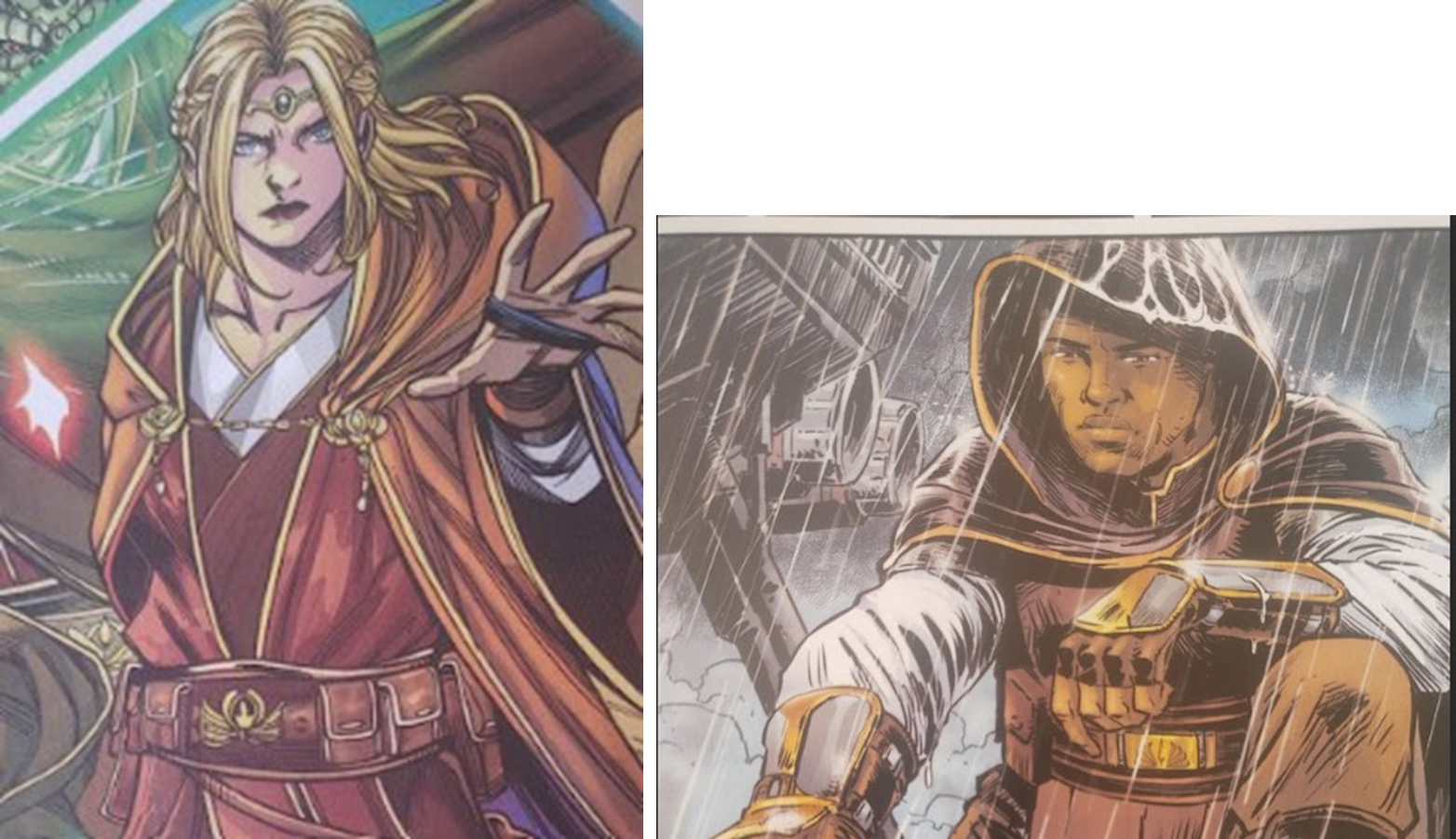
Capes/Cloaks
- Capes and cloaks may fasten asymmetrically
- Capes and cloaks may have an added capelet layer in the shoulder area. If this layer is included, it should be the same color(s) as the rest of the cape or cloak.
Robes
- Robes may have ¾ length sleeves so long as the outer or inner tunic is long sleeved.
Kama or Battle Skirt
The kama must be made of heavy duty fabric or leather/leather-like material in shades of brown. The kama/battle skirt must be open in the front and may fall from a minimum 3-5 inches below the belt to just above the ankles. The kama may have simple, unornamented trim and/or lining in a different shade of brown that coordinates with the rest of the costume. The fastening must be hidden at the waist under the belt. If the kama falls below the knees, the top of the kama may be pulled out to flip over the belt.
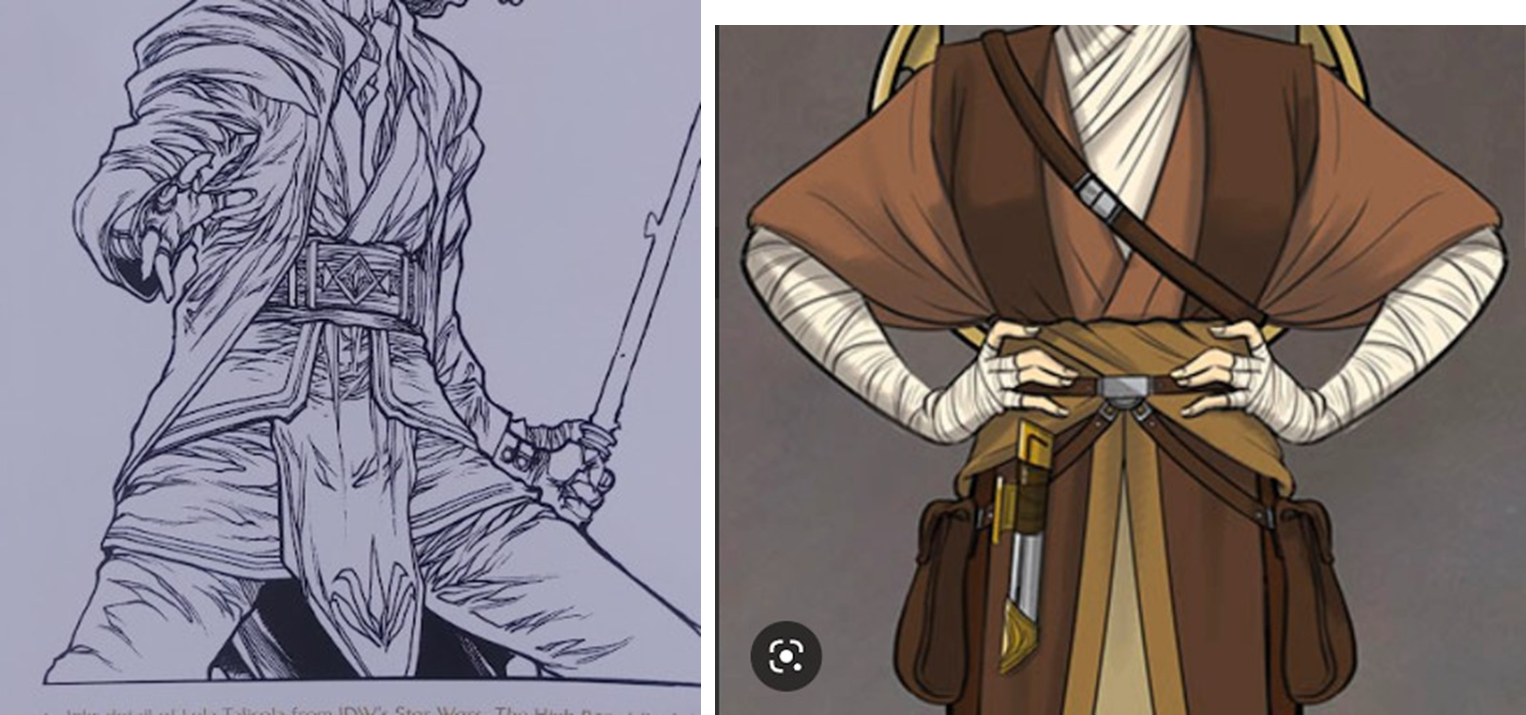
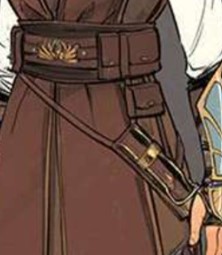
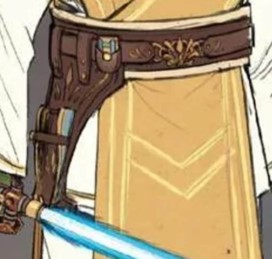
Saber Holster
Saber holsters hang from the belt. They are made of leather or leather-like material with metal accents, and should functionally suspend a saber hilt when it has no blade attached. All saber holsters should either replicate an existing design from the high republic or be pre-approved by the GCCs.
 |
 |
Forearm Guards
Forearm guards are worn over bracers and serve as armor to protect the forearms. Forearm guards are made of a rigid material and fully cover the top of the forearm. They may also include a small guard over the back of the hand. They are secured to the arm with at least two straps under the arm. These straps may be black or brown and may include small matching or metallic buckles. Forearm guards are either metallic or brown.
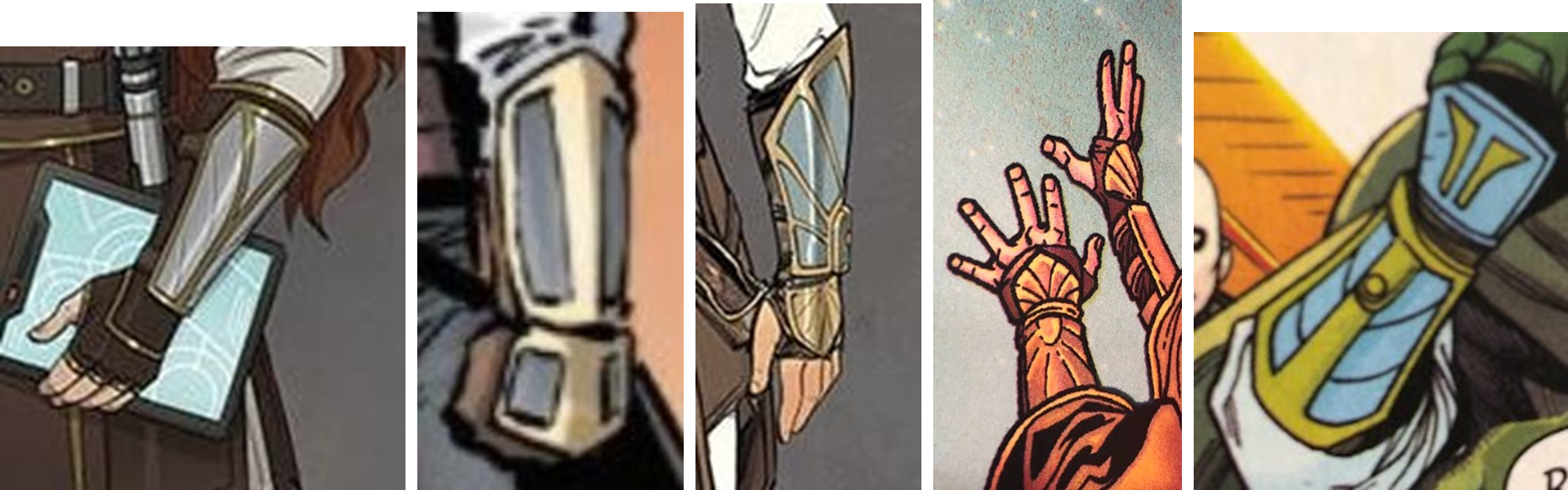
Gloves
Gloves seen in art of the High Republic are fingerless style, medium to dark brown, and tend to match the leather of the belt, though this is not required. They can be worn with the bracer and under the forearm guard, but are not required.
Shoulder Guards
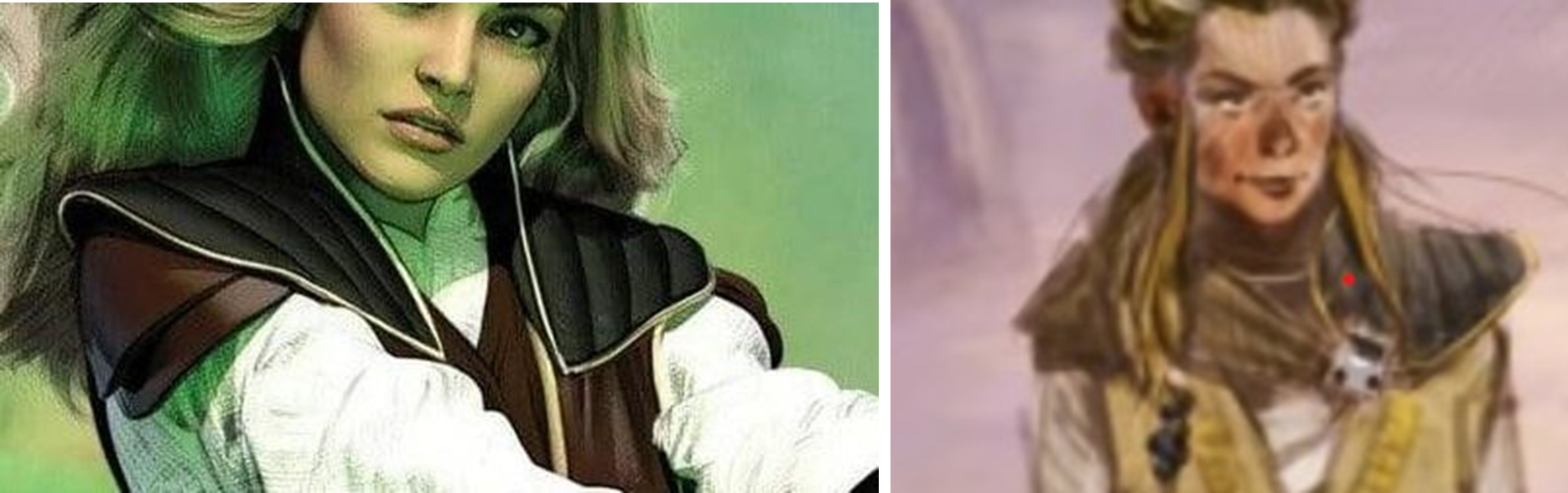
A design seen on some Jedi, these quilted shoulder pads or guards can be worn with either style of outer tunic and sit on top of the tabards. They are either the same color as the outer tunic, or darker brown in color. They do not meet or fasten in the front and must be securely fastened at the shoulders. Shoulder pads include a high collar and have 3- 4 quilted vertical segments. They should also have gold piping around the edges of the shoulder guards. A single shoulder pad may be used if securely fastened.
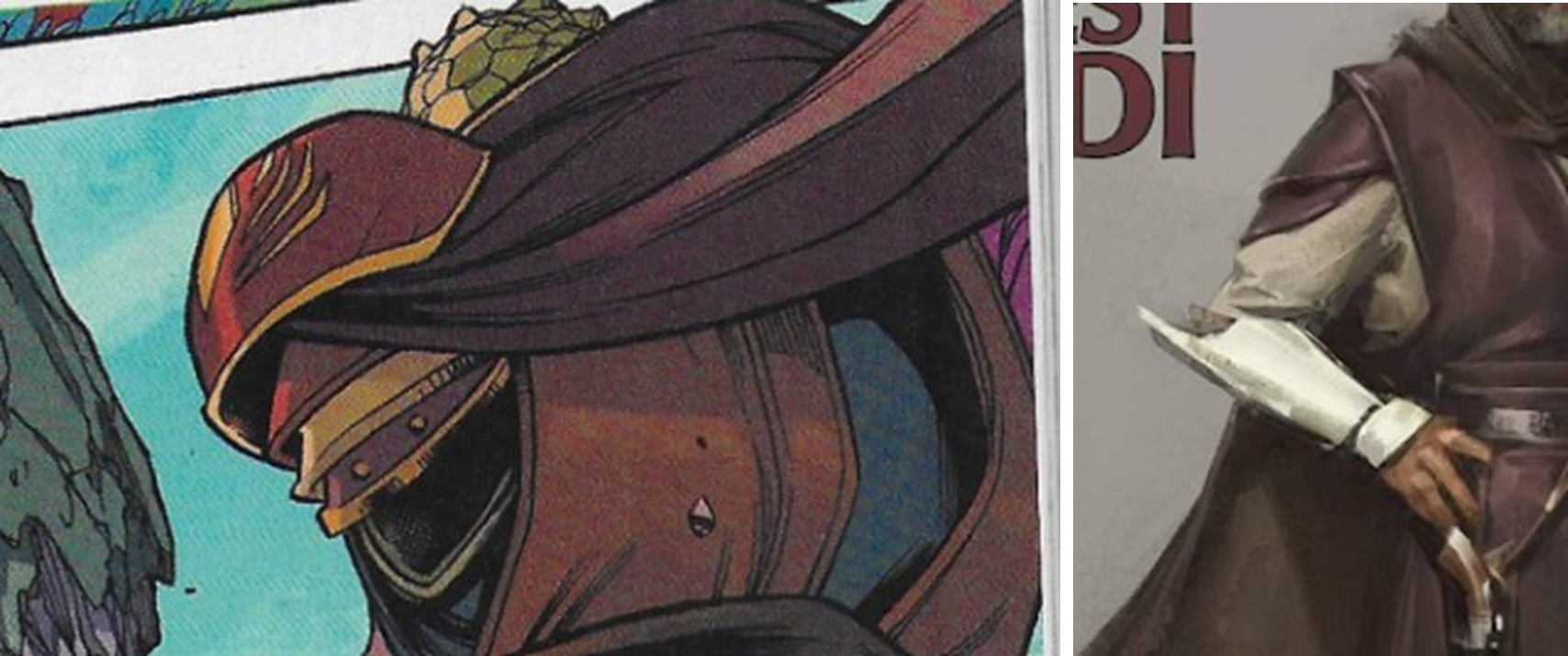
Armor
High Republic armor follows all the rules of the standard addendum EXCEPT:
- Simple heraldry of common High Republic symbols is allowed (see Gauntlets for examples).
- High Republic armor is primarily found on the shoulders, forearms and hands. Armor in other locations will need to be reviewed on a case-by-case basis
The Acolyte - Jedi Mission Uniform
The Acolyte – Jedi Mission Uniform
This template was developed independently from the Rebel Legion Costume Standard. It is advised that any applicant or member looking for cross-approval review both standards. It is our intention to NOT have any costume element that outright contradicts the Rebel Legion standard. Where the standards do not 100% agree, we have left an option for a Rebel Legion compliant color or item.
Description
The mission uniforms seen in The Acolyte are distinct from both the preceding High Republic Era and the following Prequel Trilogy Era. Mission Uniforms from The Acolyte show much less individuality than those in either the High Republic or Prequel Trilogy era. A group of Jedi from The Acolyte era look largely the same, with small details differentiating characters.
This standard depicts the costumes as they appear in “present day” during the show. The costumes in the flashbacks are slightly different, most notably the tabards.

Minimum Requirements:
- Outer Tunic
- Inner Tunic
- Trousers
- Tabards
- Obi
- Belt
- Saber Clip
- Comlink
- Food Capsules
- Boots
- Gloves (Not Applicable for Padawan)
- Forearm/Hand Armor (Not Applicable for Padawan)
- Lightsaber
Optional Requirements:
- Pouch
- Cloak
Fabrics
Although not as ornate as the costumes seen in the High Republic Era, the fabrics for the Mission Uniform from The Acolyte show much less variety than those of the Prequel Trilogy Era.
|
Recommended Materials |
Weave/Type |
|
Linen and Linen Blends |
Hopsack, Suiting, Twill, Muslin, Upholstery-Weight (no vinyl backing) |
|
Silk |
Tusseh, Noile |
|
Cotton and Cotton Blends |
Canvas, Duck, Suiting, Osnaburg, Crinkle Gauze[1], Twill |
|
Wool |
Twill, Suiting |
[1] This must generally be lined in order to be used, and may be used for inner tunics only.
Minimum Requirements:
Outer Tunic


Note: Outer and inner tunic

Color charts are meant to be a guideline and not an exact match. Any color that matches the wording within the standards is fine.
The Outer tunic is of classical design, similar in cut to the Prequel Era Outer Tunic with no customization.
The outer tunic must be long enough to at minimum cover the groin and rear, with a maximum of knee length. High-Low Tunics are not permitted.
Most, but not all of the Jedi on the show wear outer tunics with no trim at the neckline (None of the main characters have the trim). Therefore this feature is optional, with up to a 2 Inch (5cm) trim permitted at the neckline.
Outer tunic should be a medium khaki color, similar in shade to the color depicted above.
The bottom of the “V” where the front of the tunic crosses over should fall notably above the obi. Tunic fit should be adjusted to fit the applicant’s body type.
Outer Tunics cross left over right in The Acolyte, but so long as they cross the same way they are approvable.
Outer tunics should have slits up the sides. Slits up the side can reach up to the obi.
Outer tunics must have full sleeves. Sleeves should be narrower than prequel-era “bell” sleeves. Sleeves must reach at a minimum the wrist but not exceed the first knuckle in the hand when arms are held out to the sides at a 45 degree angle and with arms straight (no bend at the elbow).
Inner Tunic
The inner tunic is of classical design. The inner tunic has a trim around the neckline. The trim is up to 2 inches (5 cm) around the neckline.

Color charts are meant to be a guideline and not an exact match. Any color that matches the wording within the standards is fine.
The inner tunic is a medium dark brown, similar in shade to the color depicted above.
Optionally, the inner tunic can be the same gold fabric used for the tabards.
If brown fabric is used it may optionally have a ribbed pattern with the ribbing running parallel to the neckline. If gold color is used, no pattern is permitted.
Inner tunics can either be full sleeved or a dickey that mimics the look.
If done as a dickey, the dickey should give the appearance of being a full inner tunic, though visible undersleeves are not necessary unless specific to a character.

Note: Optional gold inner tunic. This appears to be worn by Knights/Masters only.
Pants
Pants follow all rules from the main addendum EXCEPT: They must be in shades of tan or brown.
Pants should be opaque, including where the fabric stretches over the knees.
Pants should sit at the waist (so any pockets present are not visible), and be of a relaxed fit. They should not blouse out excessively over the tops of the boots when tucked in. No visible logos or patterns are allowed. Denim is not an acceptable material for pants
.

Note: Pants
Be like Jord and steam or iron your kit before missions!
Tabards

Color charts are meant to be a guideline and not an exact match. Any color that matches the wording within the standards is fine.
Tabards for The Acolyte temple robes are made of gold silk or fine linen, self lined, and with a visible but neat texture.
Tabard minimum length is at the hem of the tunic or skirt. Maximum length is 6”/15.25 cm longer than the hem of the tunic.
Jedi Knights and Masters Tabards
Jedi Knights and Jedi Masters wear traditional shoulder tabards.
Shoulder Tabard width/size should be even on the left and the right side. The width of the tabard should be consistent throughout the garment until the end.
Optionally, Tabards are decorated with a gold border trim along the outside edge and inside neckline, front and back. The trim should be spaced just inside the outside border of the tabards. A military style trim with raised edges is preferred.
Optional: Jedi Knights may wear Vest-Style Tabards following the construction rules below.
Jedi Padawans wear Vest-Style Tabards
Vest style tabards must have a clearly defined split in the front to show the inner and outer tunics both above and below the belt. The rear of the tabard is solid across the back, running down the back.
For the front portion of the vest-style tabards, the width/size should be even on the left and the right side. The width of the front portion of the tabards should be consistent throughout the garment until the end.
The width of the rear portion of the tabards should be consistent throughout the garment until the end.
Vest tabards have a split all the way up the side and are not permitted to wrap around the body.
Padawan Tabards have no trim.

Note: Padawan tabards have no trim
Obi
Jedi Knight/Master Obi
Obis are square in design and are larger than the belt up to 2 inches past the edge of the belt.
Obis should close in the rear.
The obi is dark brown.
Optional: The Obi should include two narrow strips of the same fabric, set on either side of the belt in back. They hold the belt in place and are held in place themselves by brass rivets just above and below the belt.
Padawan Obi
Obis are square in design and are larger than the belt up to 2 inches past the edge of the belt.
Obis should close in the rear.
Padawan characters wear a dark green instead of brown obi.

Color charts are meant to be a guideline and not an exact match. Any color that matches the wording within the standards is fine.
The Obi should include two narrow strips of the same fabric, set on either side of the belt in front and back. They hold the belt in place and are held in place themselves by brass rivets just above and below the belt.
The canon fabric for the padawan obi is wool felt, but any of the approved fabrics are suitable.

Note: Padawan green obi.
Belt
Belts are brown leather with metal accents and gold buckles. The preferred color for accents is brass, but we do not require brass.
Belt construction should be based on prequel based belts, featuring the classic two-layer construction with a wider belt and a narrower center belt, with studs.
The wider belt should be between 3 and 5 inches. Note this is wider than standard prequel belt sizes.
Wider belts include parallel lines of etching along the upper and lower edge.
The leather of belts is not embossed with patterns or heraldry
Both the narrow belt and wider belts end in the back, overlapping to close with stud attachments through punched holes. The wide belt closes first and the narrow belt closes over the top of it.
Buckles may be round, oval, or rectangular and are embossed with the jedi order symbol.


Note: Belt examples. Note the rear closure.
Saber Clip
Belts must feature a lightsaber clip.
The clip hangs from a short brown leather strip, attached just under the narrow overbelt.
The clip is covertec style..
The covertec clip should hang just below the bottom edge of the belt.
Covertec clips may be silver, gunmetal, antique brass or black.

Note: Covertec on strap and covertec clip.
Commlink
The commlink is carried in a leather loop attached to the center belt.
The commlink is cylindrical, approximately 4 inches (10 cm) tall, and silver.
The commlink is ridged.

Note: Commlink Examples
Food Capsules
Food capsules are metallic silver in color
There are two different styles
Jedi wear one set of food capsules
Prequel Era food capsules are not permitted:

Note: Food Capsules
Boots
Boots follow all rules of construction and fit from the main addendum. The exception being that wrap boots are not allowed for this template.
Boots may include a narrow strip of matching leather that covers the inside zipper.

Gloves/Forearm Hand Armor (Not Applicable for Padawan)
Forearm/Hand Armor (Not Applicable for Padawan)
Jedi Knights and Masters wear gloves and forearm/hand armor
Gloves are leather or pleather
Gloves extend to mid-forearm over the outer tunic. A shorter glove with a leather bracer may be used to simulate this look.
Gloves have no stitching or details
Forearm/hand armor is dull silver metallic with raised detailing
Armor is attached to the forearm over the glove via visible black straps.

Note: Glove and Forearm/Hand Armor
Lightsaber
Lightsabers should be combat ready, able to securely hold the blade style of choice of the Temple, and not easily break during choreography.
Jedi colors include various shades of the following: Blue, Green, Yellow, Amber.
For this era, lightsabers are limited to standard hilts. Saber staves, saber pikes are not permitted.
Although we do see a lightsaber whip, it is limited to a face character and is not permitted within the scope of this standard.

Note: Acolyte Era Lightsabers
Optional Requirements:
Optional - Pouch
As we only definitively see a pouch on Torbin in the flashbacks, pouches are optional for this standard.
If worn, the pouch should be formed and made of thicker leather or pleather.
Pouches should be securely attached to the belt
Pouch should be square or rectangular in shape, and no taller than the width of the main wider belt.
Pouch should have a flap closure with a metallic snap. Color of the snap should match the color of the hardware on the belt.
No more than two pouches should be worn.


Note: If you look REAL close, you can possibly see a pouch on Sol’s belt. Torbin definitely has pouches.
Optional - Cloak
Although all of the Jedi with the exception of Kelnacca wear cloaks throughout the series and do not remove them when fighting, for the purposes of practicality and safety, cloaks are optional under this standard.
Cloaks should be dark brown in color.
Cloaks should be either brushing the ground or no more than ankle length.
Sleeves of the tunic should not show below the sleeve of the cloak when arms are hanging naturally by the sides. It is preferred but not required that cloak sleeves be narrower than prequel-era cloaks to more closely match the on-screen examples. The main characters have narrower cloak sleeves, the supporting characters have both narrow and wide (prequel style) cloak sleeves.
Hood should be large, and should sit in folds on either shoulder. Hoods should not have a pointed top and should not look as though they came out of Assassin’s Creed.
Cloaks should be voluminous, but should not be so large that the applicant gets “lost” in it. Witches cloaks/robes, vampire cloaks, or bathrobes are not approvable.
Recommended fabrics are those that are heavier weight and made out of natural fiber. Lighter fabrics with little to no weight are not recommended.

Note: Nobody likes a wrinkled robe.
The Acolyte - Jedi Temple Uniform
The Acolyte - Formal Temple Uniform
Description
The Acolyte formal temple uniforms are worn by Jedi in the later High Republic era at the Jedi temples and on official business. They are generally clean, luxurious, and elegant.
The colors are ivory or white for the outer tunic and the under tunics, obi, and cape, rich gold for tabards, and tan for the pants.
This template was developed independently from the Rebel Legion Costume Standard. It is advised that any applicant or member looking for cross-approval review both standards. It is our intention to NOT have any costume element that outright contradicts the Rebel Legion standard. Where the standards do not 100% agree, we have left an option for a Rebel Legion compliant color or item.
Minimum Requirements
- Outer Tunic
- Inner Tunic
- Tabards
- Obi
- Jedi Belt with The Acolyte style lightsaber clip on a leather strip
- Pants
- Boots
Optional Item
For the purposes of Saber Guild, the cape is optional for both Jedi Knights and Padawans.
If going for cross-club approval include the cape.
Colors
All items not made of leather or metal share similar color schemes of gold and white/cream across temple outfits except where otherwise stated. Tabards should be a rich gold ranging from honey to turmeric to gold. Outer tunics and obis should be an ivory or off white color and capes should be of a matching color and fabric. Inner tunics are also off white to ivory colored but should be a different shade from outer tunics. Pants should be light brown or tan.
For Padawans only: obis are a dark green color to indicate padawan status.
No three color rule exists within the Later High Republic (Acolyte)
Color charts are meant to be a guideline and do not need to be matched exactly. Any color that meets the wording of the standards will be approved.
White/Ivory/Creams
Used for inner tunics, outer tunics, obi (for Knights and Masters), and cape. Inner and outer tunic should have variation between the two shades.

Golds
Used for tabards and trim. Tabards should be a rich gold ranging from honey to turmeric to gold.

Dark Green
Padawans have a dark green colored obi to indicate their rank within the Order.
Light Brown
Used for pants. Most commercially available tan and khaki pants would fall either in this range or slightly lighter.

Materials
Materials should be fine quality silks and linens, particularly silk matka. Boots and belts should be leather or leather like. All clothing parts should be of a durable material of medium weight and not be see-through in any capacity. Materials used should not have additional patterns.
Recommended Fabrics
Fine linen, silk matka
Disallowed Fabrics include:
Anything thin enough to be see-thru, shiny, has a sheen, or has a raised pattern. No quilting cotton, cotton sateen or sheer linens. Rough, worn fabrics including homespun cottons and slubby linens and wools.
Smooth satins including habutais, velvets, velveteens, most other cottons (including cotton gauze and osnaburg), leather for items other than boots/belts/belt accessories, any other fabrics referenced in the main addendum as being unapprovable
Belts, pouches, saber holsters, and boots must be leather or leather-like.
Outer Tunic
Outer tunics are worn over the inner tunic and pants, but under tabards, obi and belt. The outer tunic should be a shade of ivory or off white. Outer tunics should have a crossover neckline with an optional approximately 2” border of the same fabric and top stitching along the border o
f the neckline. Some tunics can also have a crossover front with no border trim and no top stitching. Outer tunics should follow all construction rules of the main addendum unless otherwise stated. Outer tunics must be long enough to cover the crotch/backside and may extend to the knee.

Inner Tunic

Inner tunics in the High Republic era are white or off white. They are long sleeved and should be tucked into the pants or skirt. They share the cross-over design of the standard Jedi over tunic. When worn with a standard cross-over outer tunic, the inner tunic’s collar should be visible. They can include pleats running the length of the neckline.
Tabards
Tabards for the Acolyte temple robes are made of gold silk or fine linen, self lined, and with a visible, but neat texture. Tabards are decorated with a gold border trim along the outside edge and inside neckline, front and back. The trim should be spaced just inside the outside border of the tabards. A military style trim with raised edges is preferred.
Tabards can be shaped as one of two styles for Jedi: The standard draping over the shoulder tabard or apron style tabards. Padawans must use the Padawan style vest tabard.
Standard Tabard
This is the ‘modern Jedi style’ draping over the shoulder tabard. This style can be worn as standard parallel lay or y-shaped. Tabards should be the same length as or longer than the outer tunic and range in length between the mid-thigh and knees.


Y Front Tabard
Tabards may also be Y-front with apron bottom front and back. If this style is used, the top back portion may be cut as a medieval style or also as a crossover, falling into the apron bottom below the obi. Tabards should be the same length as or longer than the outer tunic and range in length between the mid-thigh and knee.
s


Padawan Tabard
Padawans exclusively wear vest style tabards, which are cut in two pieces draping down in the front and a solid top and bottom in the rear. Tabards should be the same length as or longer than the outer tunic and range in length between the mid-thigh and knees.

Obi
Obis are square in design and are larger than the belt up to 2 inches past the edge of the belt. They match the ivory of the outer tunic. They should include two narrow strips of the same fabric, set on either side of the belt in front and back. They hold the belt in place and are held in place themselves by brass rivets just above and below the belt.

Padawan Obi
Padawan characters may choose to wear a dark green instead of ivory obi. The canon fabric for the padawan obi is wool felt, but any similar style fabric is suitable. Obis should be of similar construction including the strips running perpendicular to hold on the belt.


Belt
Construction and Design
High republic belts are brown leather with metal accents and gold buckles. Buckles may be round, oval, or rectangular and are embossed with the jedi order symbol. The leather of belts is not embossed with patterns or heraldry.
Belt construction should be based on prequel based belts, featuring the classic two-layer construction with a wider belt and a narrower belt. The wider belt should be between 3 and 5 inches. Note this is wider than standard prequel belt sizes. Wider belts also include parallel lines of etching along the upper and lower edge. Both the narrow belt and wider belts end in the back, overlapping to close with stud attachments through punched holes. The wide belt closes first and the narrow belt closes over the top of it


Lightsaber clip
Belts must feature a lightsaber clip. The clip hangs from a short brown leather strip, attached just under the narrow overbelt and has a silver covertec style lightsaber at the bottom. The covertec clip should hang just below the bottom edge of the belt.

Boots
Boots follow all rules of construction and fit from the main addendum. The exception being that wrap boots are not allowed for this template. Boots of the acolyte era may include a narrow strip of matching leather that covers the inside zipper, but it is not required.


Pants
Pants follow all rules from the main addendum EXCEPT: They must be in shades of tan or light brown.
Saber
Sabers follow all rules from the main addendum. High republic features such as gold ornamentation are permitted but not required.
Cloak or cape (Optional for Saber Guild)

Capes are cut as a half circle with an attached hood. Hoods should include pleats where attached to the cape and should fall to just below the shoulder blades.
Capes include a 2 to 3 inch border trim of matching fabric along the front edge. Cape can also have a 2 inch border trim around the bottom edge optionally.
They may end between calf length and ankle length.
Capes and cloaks may fasten with a white or similarly colored hook and eye closure just below where the hood meets the cape edge in the center front.

Less commonly capes could be a straight cut rectangle that falls down the back just below knee length. The top of the cape fits over the shoulders in an oversized cowl neck collar. Cape should be made from the same material and ivory color as the outer tunic.